by BLDCBlog-Admin | Jul 28, 2026 | Marketing, Printing
The sale is not the finish line.
Marketing,
The businesses that answer these questions early often create a smoother customer experience from the start.
That’s where a welcome kit can help.
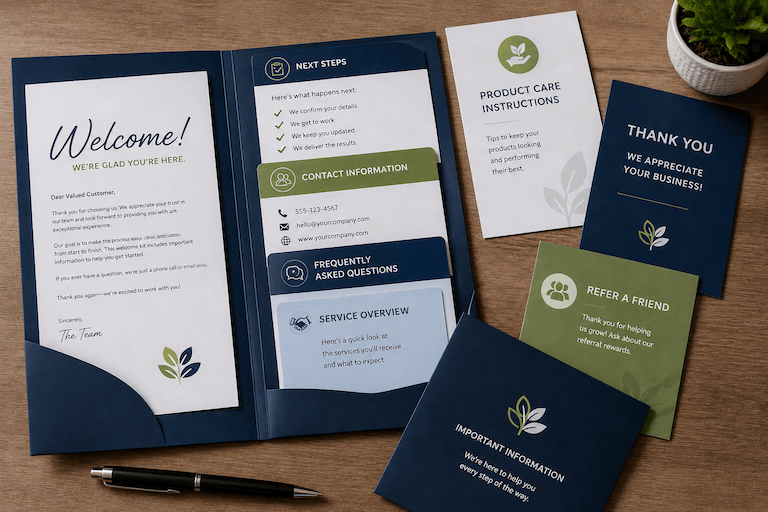
A welcome kit is simply a collection of information that helps new customers understand what to expect and where to find answers. It doesn’t need to be elaborate. It just needs to be useful.
Answer the Questions Customers Already Have
Think about the questions your customers ask most often after they make a purchase.
Many businesses answer the same questions repeatedly because customers don’t know where to find the information.
A welcome kit helps organize those answers in one place.
Depending on your business, that might include:
- Key contact information
- Next steps in the process
- Expected timelines
- Support resources
- Frequently asked questions
When customers know what to expect, they spend less time wondering and more time feeling confident about their decision.
Just as importantly, your team spends less time responding to routine questions.
Include the Pieces That Make Sense
A good welcome kit doesn’t need to be packed with paperwork.
Instead, focus on providing materials customers are likely to reference later.
Common items include:
- A welcome letter
- A thank-you card
- Contact information
- A service overview
- Frequently asked questions
- Product care instructions
- Warranty information
- A referral or loyalty offer
Some businesses also package these materials in a pocket folder to keep everything organized and easy to access. Pocket folders are commonly used to present information professionally while keeping multiple documents together.
The exact contents will vary by industry, but the goal remains the same: make life easier for the customer.
Keep It Clear and Useful
One of the biggest mistakes businesses make is including too much information.
A welcome kit should reduce confusion, not create more of it.
Use plain language. Keep instructions straightforward. Organize information in a logical order.
Ask yourself:
- Can customers quickly find important phone numbers?
- Are next steps easy to understand?
- Is the information still current?
- Would someone unfamiliar with the process know what to do?
A clean, organized packet often provides more value than a thick stack of materials that never gets read.
Consistency also matters. When your welcome materials reflect the same branding, tone, and professionalism customers experienced during the sales process, it reinforces confidence in their decision.
Confidence Starts After the Yes
Many businesses invest significant time and effort into attracting new customers. Fewer spend time thinking about what happens immediately afterward.
A simple welcome kit can help bridge that gap.
By organizing helpful information, answering common questions, and setting clear expectations, you make it easier for customers to move forward with confidence.
The best welcome kits are not the most elaborate.
They are the ones that make customers feel informed, supported, and glad they chose your business.

by BLDCBlog-Admin | Apr 18, 2025 | General, Marketing, Printing
Customers expect more than generic messaging. They want content that speaks directly to them and are 80% more likely to purchase from companies offering tailored experiences.
From variable data printing to custom direct mail campaigns, personalized print marketing can increase engagement, drive brand loyalty, and deliver a higher return on investment. Plus, with today’s advancements in variable data printing, personalized print campaigns are more affordable than ever—meaning you get a higher return on your marketing dollars. If you’ve ever wondered how to make your printed materials more relevant and impactful, this guide is for you.
Why Personalization Works in Print Marketing
Customers Pay More Attention to Personalized Print
Personalization makes customers feel valued.
Studies show that people are more likely to engage with direct mail that includes their name, purchase history, or other relevant details. Unlike digital ads that can be easily ignored, a personalized print piece captures attention and encourages action.
Do you work in real estate? Send out postcards featuring recently sold homes in a recipient’s neighborhood, making the message feel highly relevant and timely.
It Increases Response Rates and ROI
Personalized print campaigns outperform generic mailers because they speak directly to the recipient’s needs and interests.
The Data & Marketing Association states direct mail response rates increase by 135% when personalized elements are included.
Are you a nonprofit? You can use variable data printing to tailor donation requests based on a recipient’s past contributions, which will increase your response rate and donations.
Print Personalization Creates a Competitive Edge
The new standard in exceptional service is providing customer delight rather than just satisfaction.
By integrating customized print materials into your marketing strategy, you stand out in a cluttered inbox and connect with customers in a tangible way.
Do you own a restaurant? Print customized birthday coupons for regular customers, making them feel special and encouraging return visits.
How to Personalize Your Print Marketing for Maximum Impact
Use Variable Data Printing (VDP)
Variable data printing allows you to personalize each print marketing piece with unique customer information—names, images, messages and even offers—without slowing down the printing process.
- Personalized Postcards – Address customers by name and feature location-specific promotions.
- Custom Newsletters – Include different content based on customer preferences.
- Targeted Catalogs – Showcase products based on past purchases or browsing history.
Segment Your Audience for Targeted Campaigns
Not all customers are the same.
Segmenting your audience based on demographics, behavior, or purchase history can help you create highly relevant print campaigns.
- Retail: Offer product recommendations based on previous purchases.
- Healthcare: Send reminders for upcoming appointments tailored to the patient.
- Education: Provide course recommendations based on past enrollments.
Combine Print with Digital Personalization
A multi-channel approach boosts engagement and ensures your message is seen across multiple touchpoints.
- Use QR Codes: Direct customers to a personalized landing page.
- Follow Up with Email: Reinforce your print message with an email campaign.
- Personalized Call to Action: Encourage customers to take the next step, whether it’s a phone call, website visit, or store visit.
Get Started with Personalized Print Marketing
If you’ve been hesitant about print personalization, now is the perfect time to explore how customized print marketing can transform your customer engagement strategy. With cost-effective variable data printing, smart audience segmentation, and seamless digital integration, your print materials can be just as dynamic and engaging as your digital campaigns.
Let’s create a personalized print campaign that gets results—schedule a free consultation today!

by BLDCBlog-Admin | Apr 4, 2025 | Marketing, Printing
Spring is a time of renewal and growth—making it the perfect season to refresh your sales strategy. As businesses prepare for warmer months, having the right print materials in your sales toolkit can make all the difference in converting prospects into customers.
A well-equipped sales team needs more than just digital resources; print marketing provides a tangible, credible, and highly effective way to engage clients and close deals. Here are five essential print tools that will enhance your sales efforts this spring and beyond.
5 Essential Print Tools to Enhance Your Sales
1. Business Cards: Make a Lasting Impression
Nothing beats the impact of a well-designed business card.
Business cards provide a personal, tangible reminder of your brand, ensuring you stand out in a sea of virtual connections. The personal touch of handing someone a well-crafted business card fosters a connection and leaves a lasting impression.
When creating your business card, consider using:
- High-quality paper stock for a professional feel
- Clean, easy-to-read typography
- Your company logo and branding elements
- A QR code linking to your website or portfolio
2. Brochures & Sell Sheets: Inform and Persuade
When you need to dive deep into your product or service offerings, brochures and sell sheets are invaluable.
For brochures and sell sheets to be effective, ensure your messaging is clear, concise, and benefits-driven. Utilize engaging visuals that align with your brand identity and highlight your unique selling points. Consider including customer testimonials to build trust and incorporating strong calls-to-action (CTAs) to encourage further action from potential customers.
3. Direct Mail: A Personal Touch
Direct mail remains a powerful tool for sales.
With less competition in the mailbox than in the inbox, a well-designed postcard or flyer can command attention and drive engagement. To maximize results, consider these strategies:
- Personalization: Address recipients by name and tailor offers to their interests
- Seasonal Promotions: Spring-themed discounts or limited-time offers boost response rates
- QR Codes & Personalized URL: Bridge the gap between print and digital for measurable results
- High-Quality Printing: Eye-catching design and premium paper stocks elevate perceived value
Direct mail campaigns give prospects something tangible to hold onto, making your brand harder to forget.
4. Presentation Folders & Sales Kits: Organized and Professional
Nothing leaves a better impression than walking into a meeting with a well-organized and professional presentation.
A sales kit might include business cards, brochures, case studies, and pricing sheets—all designed to provide a cohesive, polished experience.
Presentation folders not only help you stay organized but also convey professionalism and credibility to your clients. It’s a simple way to make sure your sales team is always prepared to impress.
5. Signage & Promotional Materials: Visibility Equals Opportunity
Your sales toolkit isn’t just about what you hand to clients—it’s also about what you put in front of them.
Whether you’re at a trade show, hosting an event, or just looking to enhance your storefront, printed signage plays a significant role in increasing brand awareness and drawing people in.
Creative Print Marketing Ideas:
- Outdoor Banners: Promote seasonal sales and events
- Table Tents & Counter Cards: Highlight special promotions in-store
- Stickers & Labels: Reinforce messaging on packaging or giveaways
- Branded Notepads & Pens: Provide useful promotional materials that keep your brand top of mind
To build a strong sales strategy this spring, it’s crucial to integrate print materials that support your digital efforts and make a lasting impact. From business cards to brochures, direct mail, presentation folders, and signage, each tool plays a unique role in strengthening your brand presence and increasing customer engagement.
If you’re ready to refresh your sales toolkit, contact us today to explore how high-quality print materials can give your business a competitive edge!

by BLDCBlog-Admin | Mar 28, 2025 | General, Marketing, Printing
In an era where inboxes are flooded, and digital ads disappear in a matter of seconds, businesses are rediscovering the power of print. A well-crafted, tangible newsletter doesn’t just land in someone’s hands—it stays on their desk, gets pinned to a bulletin board, or is shared between colleagues. Unlike digital communication, print has longevity, making it an invaluable marketing tool that enhances credibility and engagement.
1. Print Stays Where Digital Disappears
How often do you delete an email before even opening it? The average email open rate is just 21.5%, meaning nearly 80% of marketing emails go unread. But even when an email is opened, it doesn’t necessarily lead to action—email response rates are typically around 1% or less.
In contrast, direct mail not only gets noticed but also generates action. The Association of National Advertisers (ANA) reports that direct mail response rates average 9% for house lists and 5% for prospect lists—far surpassing email marketing results.
2. A Credible, Trusted Source of Information
With the overwhelming amount of online content, consumers have become increasingly skeptical of digital ads and email promotions. Print newsletters cut through the noise by offering curated, trustworthy content in a format that feels substantial and personal.
In fact, effective sales materials, like print newsletters, help businesses build credibility. Unlike digital pop-ups or social media ads, a printed piece reflects professionalism and permanence, making your brand more trustworthy in the eyes of customers.
3. Print Newsletters Create a Deeper Connection
Think about the last time you received a printed newsletter from a company you like. Chances are, you spent more time with it than you would an email. Unlike digital content, which is often skimmed or ignored, print has a unique way of holding attention. The tactile experience of turning pages and feeling quality paper stock makes printed newsletters more engaging.
This deeper connection leads to better retention. Neuroscience research suggests that people process and recall information better when reading from print rather than a screen. This means that your newsletter’s message stays with customers long after they read it, reinforcing your brand’s presence.
4. Multi-Channel Marketing: The Best of Both Worlds
A print newsletter doesn’t have to replace your digital strategy—it should enhance it. By integrating QR codes, personalized URLs, or social media callouts, you can drive traffic from your print newsletter to your website, landing pages, or online promotions.
Businesses that combine print and digital marketing see stronger results. USPS Delivers reports that campaigns using both channels create better engagement, as print provides a physical touchpoint while digital offers instant interaction.
5. Print Is Less Disruptive, More Memorable
Digital marketing is often intrusive—pop-ups, autoplay videos, and email notifications compete for attention and can quickly become overwhelming. Print, on the other hand, offers a calmer, more intentional experience. Instead of fighting for visibility in a sea of distractions, a print newsletter allows customers to engage on their terms.
This makes print far more memorable than digital content. Studies confirm that printed materials create a stronger emotional connection, increasing the likelihood of brand recall. When your message is delivered through print, it isn’t just seen—it’s remembered.
How to Get Started with Print Newsletters
A successful newsletter isn’t just about printing—it’s about strategy. Here’s how you can create a high-impact newsletter for your business:
- Content That Matters – Share valuable insights, industry news, and tips your audience will appreciate. Avoid making it a sales pitch—position your business as a resource.
- Professional Design & Printing – High-quality paper, eye-catching layouts, and a clean design make your newsletter stand out.
- Consistent Distribution – Regular issues help build brand recognition and engagement, whether monthly or quarterly.
Bring Your Brand to Life with Print
Print newsletters are the way to go if you want your marketing efforts to have a lasting impact. A professionally designed and well-executed print newsletter keeps your brand in front of customers longer, builds trust, and enhances engagement.
Contact us today to start planning your custom newsletter and see how print can transform your marketing strategy!

by Phillip Hemingway | Mar 14, 2025 | General, Marketing
Every business wants to capture attention, build trust, and drive sales. But with so much competition, simply promoting your products isn’t enough. The key to effective marketing isn’t just what you say—it’s how you say it.
Using persuasion principles, you can craft marketing messages that truly connect with your audience, making them more likely to take action. Let’s explore six powerful persuasion techniques you can start using today.
1. Reciprocity: Give to Get
People naturally feel inclined to return favors. In marketing, providing value upfront can encourage customers to engage with your brand.
How to Use It:
- Offer free samples, consultations, or educational content before asking for a sale.
- Provide helpful print marketing materials like guides, checklists, or branded notepads.
- Send thank-you cards or exclusive discounts to repeat customers.
2. Social Proof: Show That Others Trust You
People tend to follow the crowd, especially when making decisions. If they see others benefiting from your products or services, they’re more likely to trust and choose you.
How to Use It:
- Feature testimonials and reviews in your printed marketing materials and website.
- Showcase case studies of how your business has helped other customers succeed.
- Use photos of real customers enjoying your products.
3. Scarcity: Create a Sense of Urgency
When something is in limited supply, people perceive it as more valuable. Creating a sense of urgency can encourage quicker decision-making.
How to Use It:
- Use time-sensitive offers in direct mail campaigns (e.g., “Offer expires in 7 days!”).
- Print limited-edition gift cards or event tickets to boost exclusivity.
- Highlight low-stock alerts on printed promotional materials.
4. Authority: Position Yourself as an Expert
Customers trust businesses that demonstrate expertise in their field. If you can establish authority, people are more likely to listen to and believe your messaging.
How to Use It:
- Print educational booklets, brochures, or guides that position your business as a thought leader.
- Share industry insights through newsletters and direct mail campaigns.
Use professional design and high-quality materials to reinforce credibility.
5. Consistency: Encourage Small Commitments
People like to stay consistent with past decisions. If they make a small commitment, they’re more likely to follow through with larger actions later.
How to Use It:
- Offer a free sample or trial before asking for a full purchase.
- Encourage customers to sign up for a print newsletter, then follow up with a special offer.
- Use loyalty programs where small actions lead to bigger rewards.
6. Liking: Build Genuine Relationships
People prefer to do business with brands they like and relate to. Creating authentic connections can improve customer loyalty and engagement.
How to Use It:
- Personalize direct mail with handwritten notes or custom messages.
- Feature behind-the-scenes stories in your print marketing to make your brand more relatable.
- Support local causes or host community events to build goodwill.
Persuasion is About Connection, Not Manipulation
The goal of persuasive marketing isn’t to trick customers—it’s to help them see the value of what you offer in a way that resonates. By applying these psychological principles, you can create marketing that’s not only compelling but also authentic and effective.
Ready to put these persuasion tactics to work? Let us help you create print marketing materials that captivate and convert. Contact us today!

by Phillip Hemingway | Mar 4, 2025 | General, Marketing, Printing
In a world where every marketing effort competes for attention, your printed materials must do more than deliver information—they must captivate, inspire, and be remembered. Digital printing innovations offer businesses the tools to create high-quality, personalized, visually stunning materials that stand out in any context.
Let’s explore the latest trends in digital printing and how they can help you elevate your marketing efforts.
Why Digital Printing Innovations Matter
The evolution of digital printing is transforming how businesses communicate with their audiences. These advancements offer distinct benefits:
- Personalization at Scale: Create unique pieces tailored to individual recipients with variable data printing.
- Cost Efficiency: Digital printing eliminates the need for expensive plates, making small runs affordable.
- Faster Turnaround Times: Advanced printing technologies allow for quick production without sacrificing quality.
Key Innovations and Trends in Digital Printing
1. Customization & Personalization
Imagine sending 1,000 postcards where each recipient’s name, location, or preferences are incorporated seamlessly into the design.
Variable data printing enables mass customization by altering text, images, and graphics for personalized marketing materials that resonate. A survey of 600 marketers revealed that branded, personalized direct mail is the most effective method for engaging target audiences. These campaigns increase engagement and response rates, making personalization one of the most impactful trends in digital printing.
2. Quality & Performance
Advancements in digital printing have significantly enhanced quality, speed, and performance, delivering exceptional results.
- Ultra-High Resolutions: Modern printers achieve resolutions beyond 1200 dpi, producing sharper details and precision in every print.
- Expanded Color Gamuts: High-definition color systems enable richer, more vibrant colors and seamless gradients.
These innovations ensure that digital printing meets growing demands for superior quality, particularly for luxury brands, packaging, and visual marketing materials.
3. Sustainability in Printing
Eco-conscious customers appreciate businesses that align with their values. Many printers now offer:
- Soy-Based or Water-Based Inks: These alternatives reduce harmful VOC emissions.
- Recycled Papers: High-quality papers made from post-consumer waste that maintain a professional look.
Adopting sustainable printing practices reduces environmental impact and appeals to today’s socially conscious consumers. According to the Capgemini Research Institute, 77% of executives in consumer products and retail organizations say that sustainability increases customer loyalty.
4. Hybrid Printing Systems
Hybrid printing systems combine the flexibility of digital printing with the cost-efficiency and scalability of offset printing.
This versatile approach is ideal for packaging, labels, and other high-volume applications requiring customization. Hybrid systems enable businesses to adapt quickly to market demands while maintaining production efficiency and quality.
5. Automation and Efficiency
Automation and artificial intelligence are transforming digital printing by streamlining workflows and reducing production times.
- AI in Print Optimization: Enhances color management, automates workflows, and predicts maintenance needs to minimize downtime.
- Workflow Automation: Improved prepress, color matching, and finishing processes ensure faster turnaround times and consistent quality.
These advancements make digital printing more reliable, scalable, and cost-effective, allowing businesses to focus on creativity without compromising productivity.
Avoiding Common Pitfalls with Digital Printing
While the possibilities of digital printing are exciting, it’s essential to avoid these missteps:
- Overcomplicating Designs: Keep your layout clean and ensure enhancements don’t distract from the message.
- Ignoring Your Audience: Choose trends that align with your audience’s preferences and expectations.
- Skipping Proofs: Review proofs carefully to avoid costly mistakes, especially when incorporating new techniques.
Partner with a Professional Printer to Transform Your Campaigns
By embracing digital printing innovations, you can ensure your print campaigns stand out in any setting. The process doesn’t have to be overwhelming. A professional printer can guide you through the process, helping you select the proper techniques for your goals and budget and ensure high-quality production.
Contact us today to learn how digital printing can transform your materials into works of art that leave a lasting impression.